
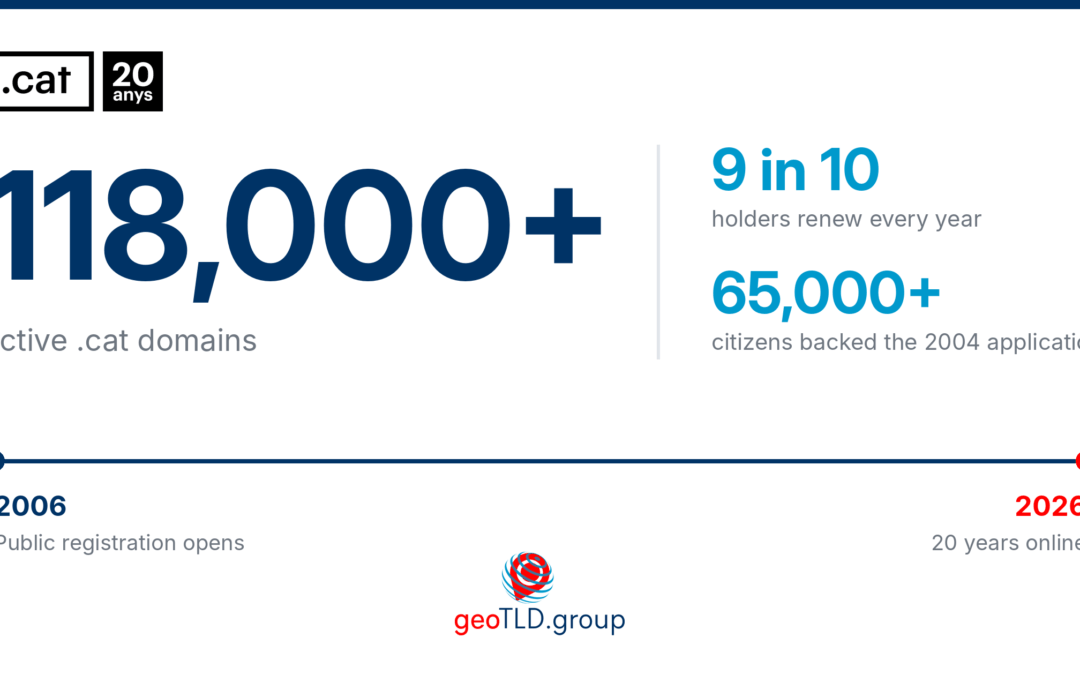
.cat was the first top-level domain built for a language and culture rather than a country or a company. Twenty years on, it has more than 118,000 active domains and nine in ten holders renew every year. Here is what that record says to anyone running or planning a geoTLD today.
In September, the team behind .cat celebrated two decades online at Barcelona’s Maritime Museum. The guest list said a lot: the Catalan government, FC Barcelona, the public broadcaster, the Institute for Catalan Studies, Catalan Wikipedia, and hundreds of ordinary .cat users.
That mix is the point. .cat grew because a community decided it wanted a home online, and then kept using it.
A domain that started as a petition
When Catalan internet pioneers first asked ICANN for a domain based on a language, the response was sceptical. One of the founders, Amadeu Abril, later recalled being asked what anyone wanted a domain for cats for.
The answer came in numbers. The formal application in March 2004 was backed by 98 organisations, 2,615 companies and more than 65,000 individual citizens. ICANN approved .cat in September 2005, and registration opened to the public on 23 April 2006, Sant Jordi’s Day. Nearly 20,000 domains were registered in the first year.
Growth that follows the community, not the market
.cat’s growth has never been a straight line. It peaked in the early years and again around 2017, then slowed as the market matured. Today it is still growing, up 4.5% year on year.
The registrations themselves read like a diary of Catalan life. Early years were full of town halls and hotels. Later waves tracked political moments and, in 2020, the pandemic. Most of those Covid-era domains were gone within two years. The ones that stay are the ones people actually use.
Loyalty you cannot buy
Nine in ten .cat holders renew every year, a higher rate than .com. That is the clearest sign the domain means something to the people who hold it.
The holder base is broad rather than concentrated. Almost half of holders own a single domain, and about one domain in ten carries a person’s name. Three in four casteller groups with a website use .cat. That is not a portfolio market. It is a community using its own address.
Bigger than the Catalan-speaking territories
.cat is not tied to a territory. It belongs to a language and culture rather than a place, so it travels with the people who share it, and .cat domains are held well beyond Catalonia.
The next challenge
Genís Roca, president of Accent Obert, the foundation that runs .cat, has pointed to artificial intelligence and large digital platforms as the next test: making sure Catalan is present in the new infrastructure of the internet, not only on websites.
Three lessons for the next generation of geoTLDs
The 2026 round attracted more than 1,600 applications. For anyone hoping to launch a city, regional or cultural domain from it, .cat offers three practical lessons.
- Build the community before the registry. .cat had tens of thousands of named supporters before it had a single domain. That support carried it through ICANN and gave it its first customers.
- Measure renewals, not launch numbers. A launch spike is easy to buy. Nine in ten holders coming back every year is not.
- Plan for decades. .cat took 20 years to reach 118,000 domains, and its operator is already planning for the next shift in how people find things online.
Not on your own
.cat has also helped other communities make their case at ICANN. That spirit of sharing experience is what the GeoTLD Group is built on. If you are preparing a geoTLD, talk to the operators who have already done it.
Find out more about the GeoTLD Group and its members at geotld.group.
Sources
- Albert Cuesta, “The 20 years of .cat in anecdotes“, Ara in English, 19 June 2026
- “20 years of Catalan culture online: .cat domain celebrates anniversary“, Catalan News, September 2026
- “La Fundació .cat es transforma en Accent Obert“, domini.cat, 4 July 2025
- “ICANN 2026 round closes with more than 1,600 new gTLD applications“, ICANN, 13 August 2026