
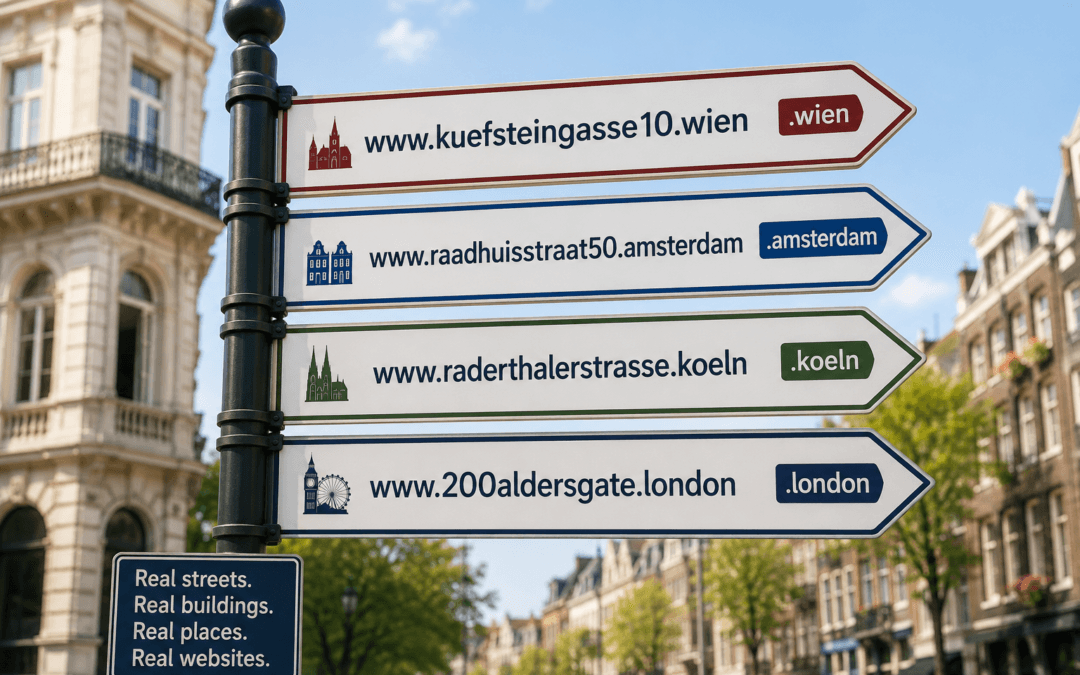
Can the address in your browser be an actual street address – the kind you’d put in a letter or pin on a map? For a growing number of businesses and property developers across Europe, that question has already been answered. And the answer looks something like this:
www.raadhuisstraat50.amsterdam
These real streets, real buildings, real places — and they exist as functional websites under geographic top-level domains. And they are creative brand names at the same time.
A use case nobody predicted
When the new gTLD programme launched and city and region domains began coming online, the primary pitch was identity. A .london domain signals London. A .wien domain signals Vienna. A .berlin domain signals Berlin. That much was obvious.
What nobody quite anticipated was that registrants would take this geographic logic to its literal conclusion: using the domain name itself as a precise physical location marker.
We first noticed this pattern between our members, where two members independently flagged it as one of the most surprising uses they had observed in their TLD ecosystems. When we dug deeper, the examples multiplied quickly.
What’s happening across TLDs
Vienna & Cologne (.wien and .koeln/.cologne)
The pattern is particularly developed here. Real estate developers and medical practices are using street-level addresses as domain names:
- www.praterstrasse.wien — a street in Vienna’s second district
- www.antonigasse12.wien — a specific building address
- www.renngasse17.wien — a property on one of Vienna’s central streets
- www.hausarztpraxis-bernhardstrasse.koeln — a GP practice identified by its Cologne street address
- www.praxis-maybachstrasse.koeln — another medical practice doing the same
The logic is straightforward: a patient or prospective buyer doesn’t need to remember a brand. They already know the address. The domain becomes a shortcut to the exact place they’re looking for.
Berlin & Hamburg (.berlin and .hamburg)
The same pattern appears in both German city TLDs, from individual streets to entire districts:
- www.mainzerstrasse.berlin
- www.hansaviertel.berlin
- www.ministergarten.berlin
- www.diewestfaelische.berlin
- www.karl-marx-strasse.berlin
- www.einplatzfuer.hamburg
- www.heiligengeistfeld.hamburg
- www.hansekai.hamburg
- www.praxis-alsterdorf.hamburg
- www.osteopathie-eppendorf.hamburg
From a historic district like Hansaviertel to medical practices like praxis-alsterdorf.hamburg, the logic holds across both cities — the address, or the neighbourhood, becomes the domain.
Amsterdam (.amsterdam) and London (.london)
Here the use case extends beyond individual properties to entire neighbourhoods and commercial streets:
- Some of these domains are really just about a single front door. www.raadhuisstraat50.amsterdam, www.rokin69.amsterdam, www.12appoldstreet.london, www.trinitypark.london and www.brigadecourt.london all tell the story of one specific building or development, using the address itself as the brand.
- Others zoom out to the scale of a stroll. www.9straatjes.amsterdam, www.javastraat.amsterdam and www.utrechtsestraat.amsterdam invite you into whole shopping streets and neighbourhoods, where many different shops, cafés and venues together create a distinct local feel.
- And then there is www.bewonersraad1011.amsterdam, which doesn’t sell anything at all but gives a voice to the people who live in postcode 1011 — a residents’ council using a geographic domain name as civic infrastructure rather than a commercial brand.
Friesland (.frl)
Here the geographic logic plays out differently but just as clearly. Rather than street addresses, the TLD is being used to represent municipalities and villages across the province — www.franeker.frl, www.heeg.frl, www.ijlst.frl — each one a community with a web presence that matches its name exactly.
Why this matters
The domain name system was designed to translate human-readable names into machine-readable addresses. What geoTLD registrants are discovering is that, in a city and region context, those two things can be the same.
A .com can be anything. A .wien domain, by definition, belongs to Vienna. That constraint — which was once seen as a limitation — turns out to be a feature. It means a domain can carry genuine geographic trust that a generic extension simply cannot.
“The best domain name is a strategic asset — and it really doesn’t matter whether it’s a brand or an address, as long as it puts you exactly where your customer expects to find you.”
— Ronald Schwaerzler, domainworx (.wien, .koeln/.cologne)
On SEO — what we know and what we’re still finding out
A domain that matches a physical address carries a local relevance signal that generic domains can’t replicate. For hausarztpraxis-bernhardstrasse.koeln, the street name is in the URL. That’s not nothing.
What we don’t have yet is hard data on how search engines — traditional or AI-powered — actually treat geoTLD domains at scale. That’s being studied now. Led by .cat and supported by the GeoTLD Group and 11 of its members, an ICANN-funded project is building an open methodology to analyse exactly this, across .barcelona, .berlin, .bzh, .cat, .cologne, .eus, .gal, .hamburg, .koeln, .london, .quebec, .scot and .wien. Results are expected early 2027.
Until then: the anecdotal case is strong.
This is just the beginning
The examples above open a broader question about what geoTLD domains are for. Not just identity or local branding, but a parallel layer of the web that maps, in a very literal way, onto the physical world.
We’re exploring this and other real-world use cases in an ongoing series. If you operate a geoTLD and have seen interesting or unexpected uses in your zone — we’d love to hear from you.