
The next ICANN round will open the door for new communities to consider their own place in the domain name system. They may include cities, regions, language or cultural communities, and applicants using scripts that better reflect the people they serve.
For anyone considering a new geoTLD, the opportunity is real. But so is the work.
Existing geoTLD operators have already learned that a geographic, cultural, or language-based domain is not successful simply because it is delegated. It becomes successful when a community understands it, uses it, trusts it, and sees itself reflected in it.
So what should a new geoTLD know before it begins?
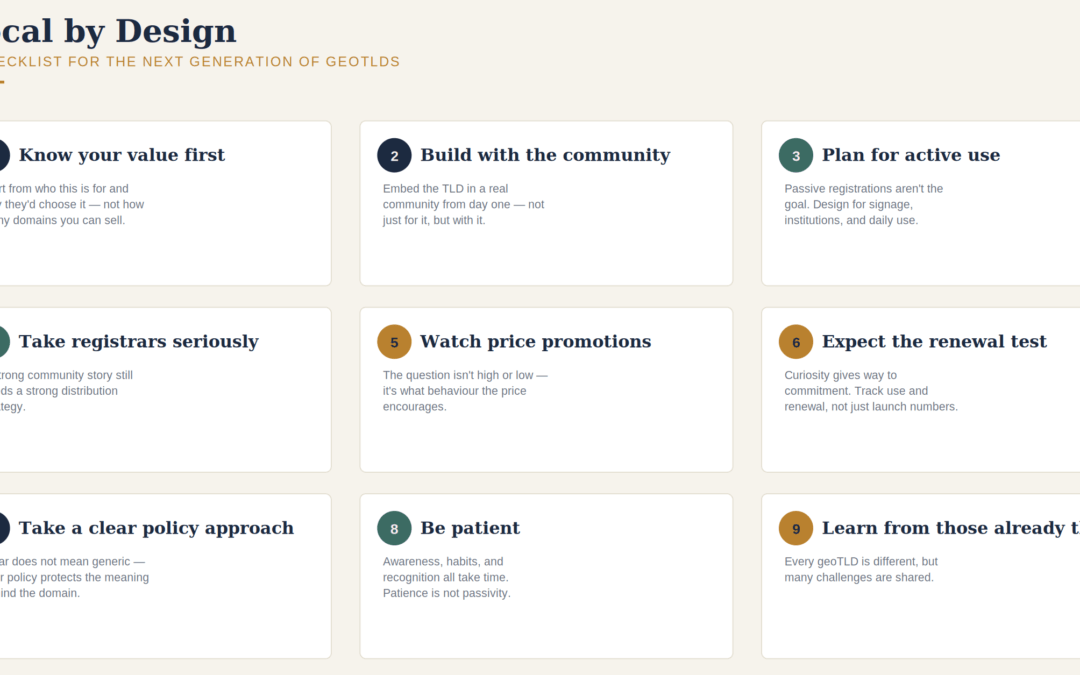
Know your value first
One piece of advice from an existing geoTLD operator says it clearly: “Be clear on your unique value and target audience.”
That may be the most useful starting point for any new applicant. A geoTLD should not begin with the question: “How many domains can we sell?” It should begin with: “Who is this for, and why would they choose it?”
A city, region, culture, or language community may all have strong reasons to want a digital identity. But those reasons need to be specific. A domain for a tourism economy is not the same as a domain for a language community. A city brand is not the same as a regional identity. A public-sector use case is not the same as a small-business proposition.
The clearer the value, the easier it becomes to explain the domain to registrars, early adopters, institutions, businesses, and the wider community.
Build with the community, not just for it
Another operator pointed to community engagement as the primary driver of growth. Their advice was to embed the TLD within a clearly defined community, whether geographic, cultural, or language based, and actively involve local stakeholders from the beginning.
This matters because geoTLDs are different from purely generic domains. Their strength comes from belonging. A geoTLD works when people feel it represents something real: a place they live in, a culture they identify with, a language they speak, or a region they want to promote.
Existing examples show this clearly. .wien is a local internet address for Vienna’s citizens, companies, and institutions (.wien). .nyc is the official web address for New Yorkers, connecting businesses, artists, and organisations through a shared love of the city (OwnIt.nyc). .barcelona speaks to local businesses, and to those entering the Barcelona market (Domini .barcelona).
The same principle applies beyond cities. .cat represents the Catalan-speaking internet community, with broad support from associations, companies, and individuals across Catalan-speaking territories (Domini .cat). .scot speaks to Scotland, Scots, and “Scots-at-Heart” around the world (dotScot). .bzh invites businesses, associations, and individuals to show their attachment to Brittany, its culture, and its languages (.bzh).
The lesson is simple: a geoTLD should not be launched as a product looking for a community. It should grow from a community that can recognise itself in the domain.
Plan for active use, not passive registration
One respondent to the questionnaire made an important distinction: community engagement encourages active usage rather than passive registrations. That difference is critical.
Passive registrations may create early numbers, but they do not necessarily create visibility, recognition, or long-term value. Active use is what makes a geoTLD part of daily digital life. It is when businesses put the domain on their signage, institutions use it in public communication, cultural organisations build on it, and local users begin to recognise it as normal.
For a new geoTLD, this means early strategy should focus on real use cases. Who should be among the first visible adopters? Which public institutions, cultural organisations, tourism actors, local businesses, or community projects would make the domain understandable to others?
A geoTLD becomes stronger when people can point to it and say: “That makes sense.”
Take registrar relationships seriously
The advice from existing operators is also very practical: build good registrar relationships early.
Registrars are not just distribution channels. They are often the first place where a potential registrant encounters the domain. If registrars do not understand the proposition, if the policies are unclear, or if pricing and promotion are difficult to manage, the domain will face friction before it reaches its audience.
One operator advised doing a strong promotion at the beginning and building good registrar relationships in the first year. That early period matters. It is when awareness is low, the story is still new, and every partner needs a simple explanation of why the domain exists and who should register it.
The practical point is this: a strong community story still needs a strong distribution strategy.
Be careful with price promotions
Pricing is another area where early decisions shape long-term health.
One operator warned against going too low with price promotions, since this can attract abuse. Another advised starting with a low wholesale price to build a base of active users, then increasing it carefully once adoption stabilises. The two views aren’t contradictory — both point to the same issue: pricing should support adoption without undermining trust or sustainability.
The real question isn’t “high or low,” but what behaviour the pricing encourages. A price that lowers friction for genuine local users helps. A price that attracts speculative or abusive registrations damages the domain’s reputation before it has one.
The first years aren’t only about growth — they’re about the type of growth.
Expect the first renewal test
One piece of advice was especially direct: be prepared to lose many domains after the first renewal.
That isn’t only bad news. The first renewal is often when early curiosity gives way to genuine commitment — some registrations won’t stay, some promotions won’t convert, and some users will discover they registered without a real plan.
The lesson is to prepare for this from the start. Track not only how many domains are registered, but how many are used, renewed, and developed into real websites, email addresses, and community assets. Long-term health isn’t measured by launch numbers — it’s measured by whether the domain stays useful after the first excitement passes.
Clear policy approach
One respondent offered another practical piece of advice: provide a clear policy on your website.
That may sound basic, but it matters. A geoTLD often carries an expectation of trust. Users want to know who can register, what the domain stands for, whether there are eligibility rules, how abuse is handled, and what kind of uses are encouraged. Clear does not mean generic — a geoTLD’s policy will rarely be as simple as a .com’s, because it exists to protect the meaning behind the domain, not just to sell names.
Clear policies help registrants, registrars, and institutional partners alike. They also help the registry itself by reducing confusion and making the domain easier to explain. If the domain is meant to represent a community, the rules around it should be easy for that community to understand — even where those rules carry real substance.
Be patient
One operator summed up the experience in three words: “You need patience.”
That may be the most realistic advice of all. A geoTLD is not built overnight. Awareness takes time. Habits take time. Registrar relationships take time. Public-sector adoption takes time. Cultural recognition takes time.
This is especially true for domains built around identity. A community may support the idea of a geoTLD before it fully understands how to use it. The role of the registry is to keep making the value clear, practical, and visible.
Patience does not mean passivity. It means steady work: explaining, partnering, improving, promoting, listening, and showing examples that others can follow.
Learn from those already operating geoTLDs
The final piece of advice from the questionnaire was simple: “join the geoTLDgroup, seek assistance in every step you take, learn from others.”
Every geoTLD is different, because every community is different. But many of the challenges are shared: launch strategy, registrar engagement, pricing, policy, abuse prevention, Universal Acceptance, and long-term adoption. Learning from existing operators can save new applicants time and help them avoid mistakes that have already been made once.
That is the promise of new geoTLDs in the next round. Not simply more names, but more ways for communities to be found, recognised, and remembered online.